This post contains imported slide content. Please review for academic accuracy.
Slide
- Insect Pest of Tomato
Slide
- Group Members Muhammad Zubair Reg#2017-uam-223 Contact 03000127002
Slide
- 1. Tomato fruit Borer. 2. Whitefly. 3. Serpentine leafminer. 4. Tomato leafminer. 5. Aphids.
Slide
- Tomato fruit Borer • Scientific Name: Helicoverpa armigera. • Order: Lepidoptera. Status Fruit borer is a serious pest of tomato as it reduces yield by up to 40%. Distribution Widely distributed in tropics, subtropics and warmer temperate regions of the world.
Slide
- • Description stages Four life stages: Egg, larva and pupa and adult. Eggs are initially white, later darkening before they hatch. Larvae are small when they emerge but can grow to about 2cm. Mature larvae are white to pinkish with a brown head
Slide
- Description stages
Slide
- Mode of damage Larval damage, especially the holes larvae make when they emerge from the fruit, can provide a pathway for disease-causing micro- organisms to enter the plant
Slide
- Non chemical Control Spray 5% Neem seed kernel extract to kill early stages larvae. Placement of 15-20 bird perches per ha helps in inviting insectivorous birds for management of the fruit borer. Use of NPV @ 250-300 LE/ha along with juggary @ 20 g/l when sprayed at 10 days interval also given protection against fruit borer. Deep ploughing after harvesting the crop to expose the pupae for natural killing affords good protection. Chemical control • Use the insecticides chlorantraniliprole, flubendiamide, cypermethrin or alpha- and zeta-cypermethrin to reduce populations. The first spray should be at the flowering stage and followed by sprays at either 10 or 15 days interval.
Slide
- Whitefly Order: Homoptera Family: Aleyrodidae Scientific Name: Bemisia tabaci Status Whiteflies are small, soft-bodied sucking insects that look like tiny white triangles, less than one-tenth of an inch long, that often rest on the undersides of plants. Several species of whiteflies may infest tomato.
Slide
- Distribution • It is distributed in tropical and sub-tropical climate including Pakistan Description stages Four description stages 1. Egg 2. Nymph 3. Pupa 4. Adult Duration stages Adult:2-5 days in summer and 24 days in november. Eggs: eggs are laid on lower and middle leavesfemale female can lay upto110 eggs. Hatch in 3-5 days in april-sep,5-17 days in oct-nov and33 days in december
Slide
- Nymph :9-14 das during april to september and 17-81 days in oct- to march pupa: 2-8 days Mode of damage 1. Sucking cell Sap 2. Injection of toxic saliva 3. Sooty mould
Slide
- non chemical control avoid cultivation of alternative host avoid use of nitrogenous fertilizers Avoid over irrigation Green lace is a effective predator Chemical control Imidacloprid Diafenthiuron Acetamiprid
Slide
- Serpentine leafminor • Order: • Diptera • Section: • Schizophora • Family: • Agromyzidae • Genus: • Liriomyza • Species: • L. brassicae
Slide
- • Food plants • wide host range, including bean, cantaloupe, celery, cucumber, eggplant, onion, pepper, potato, squash, tomato, watermelon. Ame • Description Eggs tend to be deposited in the middle of the plant; the adult seems to avoid immature leaves. Larva: The larva is legless. Adult: Adults are small, measuring less than 2 mm in length, with a wing length of 1.25 to 1.9 mm.
Slide
- • Duration stages • The average period is 21 days, can be short as 15 days.it can varies with host and temperature. Eggs are laid singly in punctures in the leaf epidermis. The eggs are small, 1/100 inch in length, and hatch 2- 4 days. • Life history • The larva crawls into the ground to pupate. A small percentage of the larvae remain hanging on the leaf and pupate there.
Slide
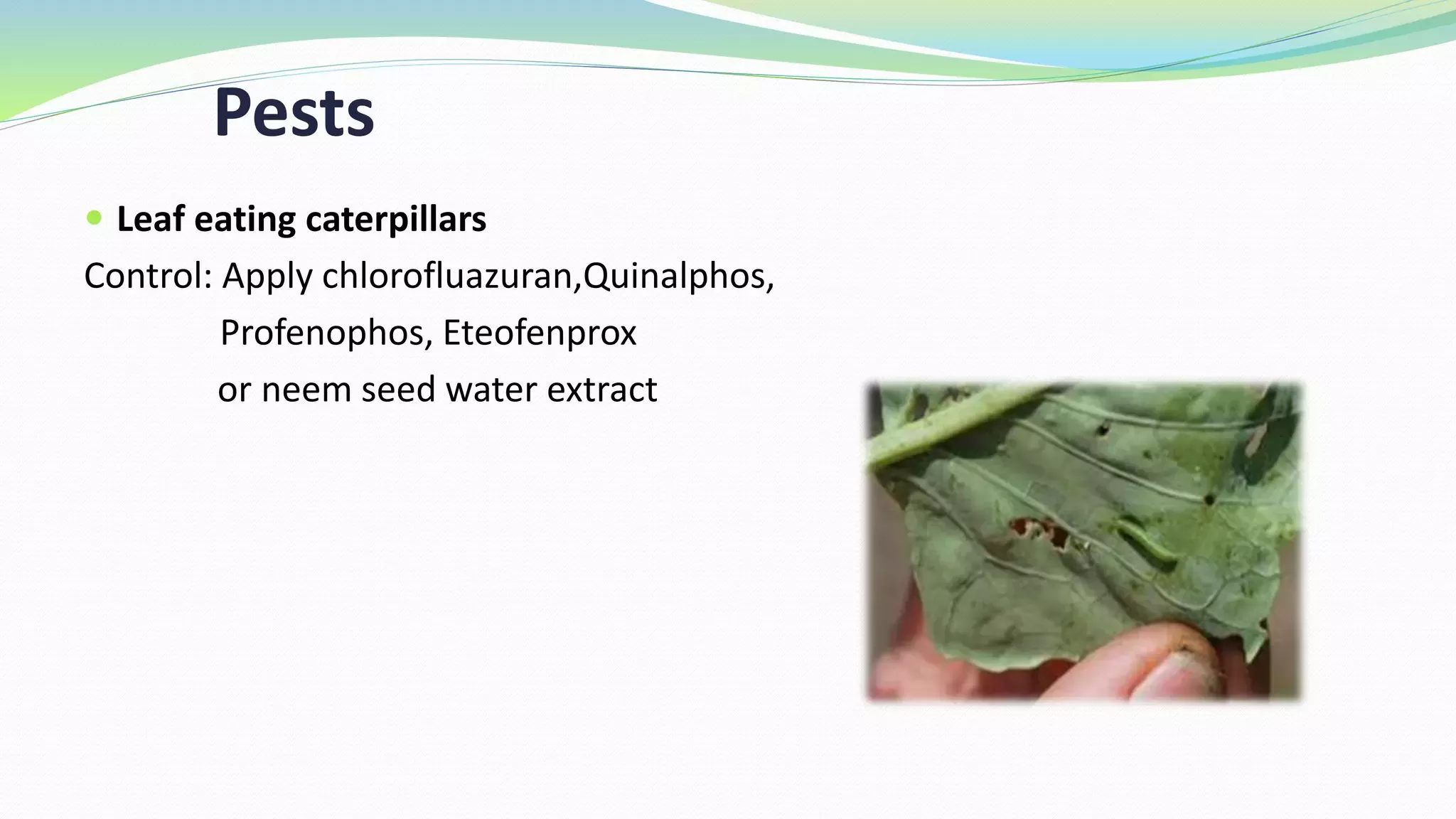
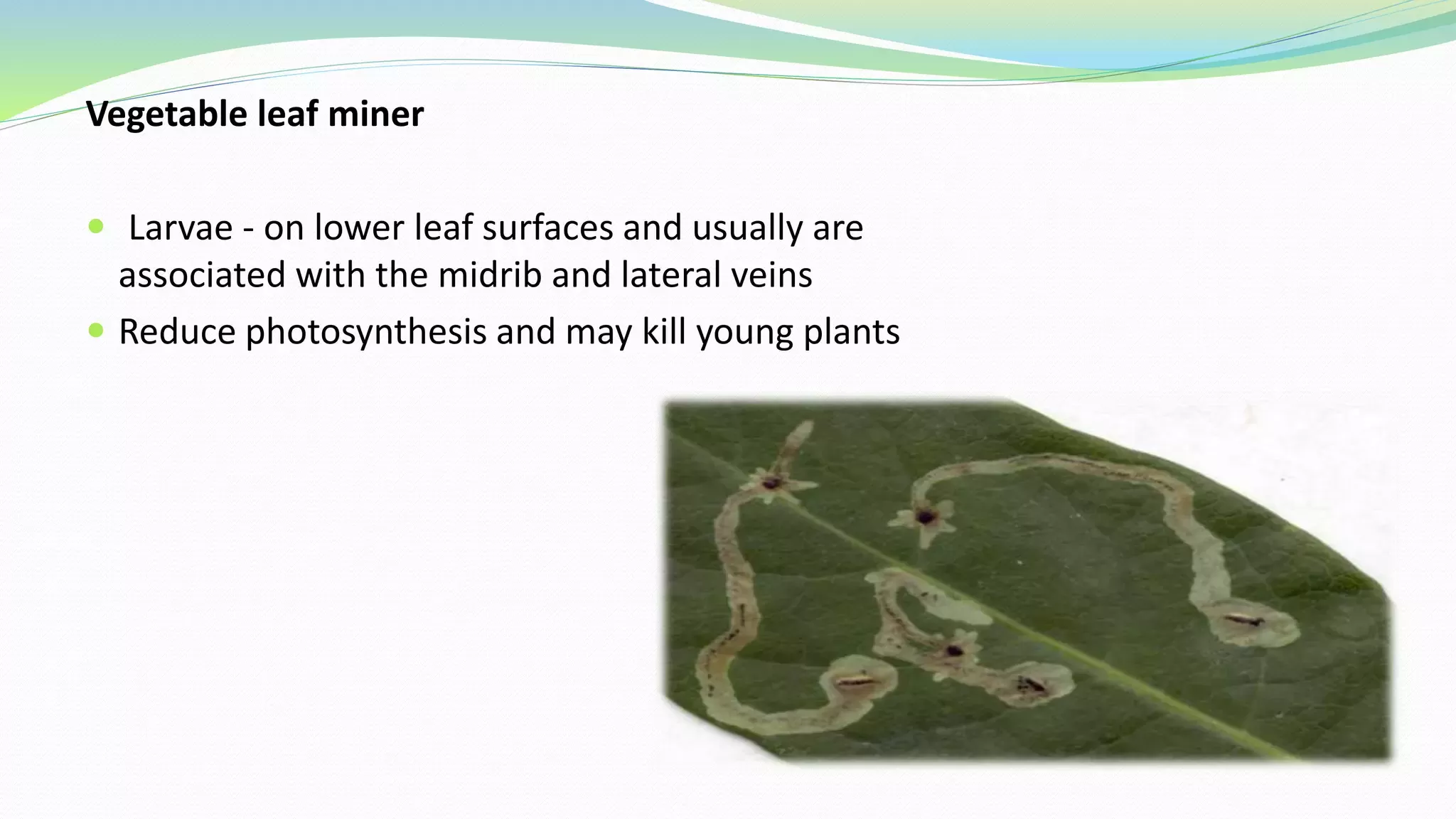
- • Mode of damage • Punctures caused by females during the feeding and oviposition processes can result in a stippled appearance on foliage, especially at the leaf tip and along the leaf margins. However, the major form of damage is the mining of leaves by larvae, which results in destruction of leaf mesophyll.
Slide
- Non chemical control • While not usually threatening to plants, leafminer control is often necessary to manage the highly visible tunnels in leaves that can reduce crop value. … Host plants include beans, blackberries, cabbage, lettuce, peppers, and a variety of ornamental flowers, citrus trees and shrubs … Chemical control • The use of pesticides (organophosphates, carbamates and pyrethroids) for the control of leafminer pests that attack vegetables will kill their natural enemies, as well as selecting resistant leafminer strains.
Slide
- Aphids • Order: • Hemiptera • Suborder: • Sternorrhyncha • Infraorder: • Aphidomorpha • Superfamily: • Aphidoidea Geoffroy, 1762
Slide
- • Food plants of a major agricultural pest • Description stagese smaller yellow form occurs during warmer summer conditions. The green form is larger and occurs during cooler spring and autumn temperatures, and uncrowded conditions. A. gossypii can range in colour from yellow to very dark (almost black) green. The smaller yellow form occurs during warmer summer conditions. • Duration stages • – The average reproductive period was 7.8-5.4 days on cotton plants while average reproductive period was 11.2-8.6 days on egg plants. The average nymphal duration on cotton plant was 4.8 to 5.8 days and in eggplant it was between 8.6 to 11.2 days.
Slide
- • Life span • .. The life span of a parthenogenic female is about twenty days in which time it can produce up to 85 nymphs. These mature in about twenty days at .. • Mode of damage • Aphid damage is usually most noticeable on shade trees and ornamental plantings. Leaves, twigs, stems, or roots may be attacked by aphids, whose mouthparts are designed for piercing the plant and sucking the sap. … Some aphid species form galls or cause distorted, curled, or deformed leaves.
Slide
- • Non chemical control • Aphis gossypii is found worldwide, wherever its host plants are grown. It prefers warm … Useful non-chemical contribution to Integrated Weed Management • Chemical control Imidacloprid Diafenthiuron Acetamiprid
Slide
- Tomato leafminor • Scientific name: Tuta absoluta • Phylum: Arthropoda • Higher classification: Tuta • Order: Lepidoptera • Rank: Species • Family: Gelechiidae • Class: Insecta
Slide
- • Description stages The life cycle of a leaf miner has the following stages: egg, three larval instars, a pupal instar and the adult fly. Adult leaf miners are small yellow and black coloured flies, at most only several millimetres long. Duration stages • he life cycle of a leaf miner has the following stages: egg, three larval instars, a pupal instar and the adult fly. Adult leaf miners are small yellow and black coloured flies, at most only several millimetres long.
Slide
- • Life Cycle • The Tomato leaf miner has approximately 11 generations per year, because they reproduce very rapidly. Its life span are is very short and it lives for about 30-35 days per generation. The adult females usually lay up to 260 eggs on a plant before its life cycle is over with • Mode of damage • Leaf miners cause damage to plants both directly and indirectly. The most direct damage is caused by the larvae mining the leaf tissue, leading to desiccation, premature leaf-fall and cosmetic damage. In (sub-)tropical areas this can lead to burning in fruit such as tomato and melon. Loss of leaves also reduces yield.
Slide
- • Non chemical control Tomato leaf miner larvae feed on leaves and fruits, from seedlings to mature tomato plants. Infestation is often followed by infections by secondary pathogens rendering infested crops unmarketable. An additional host plant of Tuta absoluta is the potato plant but not the tuber! Chemical control Tomato leaf miner is currently controlled by spraying specific synthetic insecticides.
Slide
- Pests of Tomato
Slide
- Pest of cucurbitaceous vegetables.
Slide
- Pests of tomato, Brinjal By MD. RAMAJN
Slide
- Major Insect-pests of solanaceous crop (tomato & potato) and their management
Slide
- Sorghum shoot fly
Slide
- Management of major insect pests of organically grown egglant
Slide
- Tuta absoluta
Slide
- Organic Vegetable Pest Management Updates 2013
Slide
- Pest of cruciferous vegetables
Slide
- Pests of Brinjal.
Slide
- Insect pests of citrus and their control
Slide
- Insect pests of guava and control
Slide
- Pest of potato.
Slide
- Pest of okra.
Slide
- Insect pests of banana
Slide
- Pest of chilli.
Slide
- Insect pests of Cococnut
Slide
- Pest of sweet potato.
Slide
- Pests of Mango
Slide
- pests of Cashew nut .
Slide
- Major pests of Black Pepper,cinnamon and clove
Slide
- Chilli thrips(RAKESH)
Slide
- DISEASES OF BETELVINE
Slide
- Emasculation and pollination techniques in pearl millet.pdf
Slide
- Shoot and fruit borer of brinjal
Slide
- training and pruning methods of cucurbits
Slide
- PHYSIOLOGICAL DISORDERS OF VEGETABLES
Slide
- Protected Cultivation and Secondary Agriculture (Introduction)
Slide
- Lec. 9 rkp pcgm_brinjal, tomato, chilli
Slide
- Turmeric ajith
Slide
- Lec. 5 rkp pcgm_cotton
Slide
- Pest of oilseeds
Slide
- Leaf miner and its control mechanism
Slide
- Integrated Pest Management on Okra (Abelmoschus esculentus L. Moench)
Slide
- Fruit-worm
Slide
- Insect pests of pulses (edited 23.8.08)
Slide
- Pests of tomato1
Slide
- Leaf miner
Slide
- IPM- Leaf-Miner
Slide
- Insect Pests of Vegetable, Ornamental and Spice Crops
Slide
- Lec. 10 rkp pcgm_okra
Slide
- Sign and symptoms in crops
Slide
- Pests of vegetables
Slide
- null.pptx
Slide
- SUNFLOWER INTEGRATEST PEST MANAGEMENT BY MANISH JINDAL
Slide
- Pests of Tomatopests and theirmanagement.pptx
Slide
- major pest of vegetables crops and their mgt.pptx
Slide
- Fruitworms of vegetable
Slide
- major drivers of biodiversity change.pptx
Slide
- BP303T PHARMACEUTICALMICROBIOLOGY UNIT 3
Slide
- Determining the Sample Population updated version.pdf
Slide
- BP605 T PHARMACEUTICAL BIOTECHNOLOGY UNIT 3 PART 1
Slide
- Pharmaceutical Engineering (sem-3) unit 3-2
Slide
- 2025 Caribbean Examinations Council CSEC Merit List
Slide
- Historical Background of Pharmacy .pptx
Slide
- Masking and Lithography Techniques in Microelectronics
Slide
- 10CLA Term 4 Week 6 Exam preparation reminders.pptx
Slide
- NMR Spectroscopy M.Pharm 1st Semester, Pharmacy
Slide
- Unit 7- Organ Function Test(Biochemical parameters.
Slide
- How to Get Ahead in Marketing: Insights for University Students
Slide
- Keratometer /ppt/pdf/notespdf/kerato.pdf
Slide
- What is Lost Opportunities In Odoo 18 CRM
Slide
- Principle, Construction, and Types of Varactor Diode – A Comprehensive Lectur…
Slide
- Merge similar leads and opportunities in Odoo 18 CRM
Slide
- Guidelines for Management of Libraries: KVS Library Policy-2025
Slide
- Unit 6- Heme Catabolism.pptx…………
Slide
- ENVIRONMENTAL SERVICES PROVIDERS ASSOCIATION.pdf
Slide
- An alumnus of the Swiss Management Center (SMC) University, Kwame Simpe Ofori…
Objective Questions
Q1. Which insect pest of tomato is scientifically known as Helicoverpa armigera?
A. Tomato fruit Borer
B. Whitefly
C. Serpentine leafminer
D. Aphids
Answer: A

Q2. Which order does the whitefly, Bemisia tabaci, belong to?
A. Lepidoptera
B. Homoptera
C. Diptera
D. Hemiptera
Answer: B

Q3. What is the main mode of damage caused by the larvae of tomato fruit borer?
A. Sucking cell sap
B. Mining leaf mesophyll
C. Creating holes in fruit
D. Injecting toxic saliva
Answer: C

Q4. Which of the following is NOT a recommended chemical control for whitefly on tomato?
A. Imidacloprid
B. Diafenthiuron
C. Acetamiprid
D. Flubendiamide
Answer: D

Q5. The serpentine leafminer belongs to which family?
A. Gelechiidae
B. Aleyrodidae
C. Agromyzidae
D. Aphidoidea
Answer: C

Q6. Which pest is controlled by the use of Neem seed kernel extract at 5% concentration?
A. Aphids
B. Tomato fruit Borer
C. Whitefly
D. Tomato leafminer
Answer: B

Q7. What is the approximate number of generations per year for Tuta absoluta (tomato leafminer)?
A. 2
B. 5
C. 11
D. 20
Answer: C

Q8. Which of the following is a non-chemical control method for tomato fruit borer?
A. Use of imidacloprid
B. Placement of bird perches
C. Application of acetamiprid
D. Spraying diafenthiuron
Answer: B

Q9. Which pest causes a stippled appearance on foliage due to feeding and oviposition punctures?
A. Tomato fruit Borer
B. Whitefly
C. Serpentine leafminer
D. Aphids
Answer: C

Q10. The smaller yellow form of Aphis gossypii is most commonly found during which conditions?
A. Cooler spring
B. Warmer summer
C. Autumn
D. Crowded conditions
Answer: B